
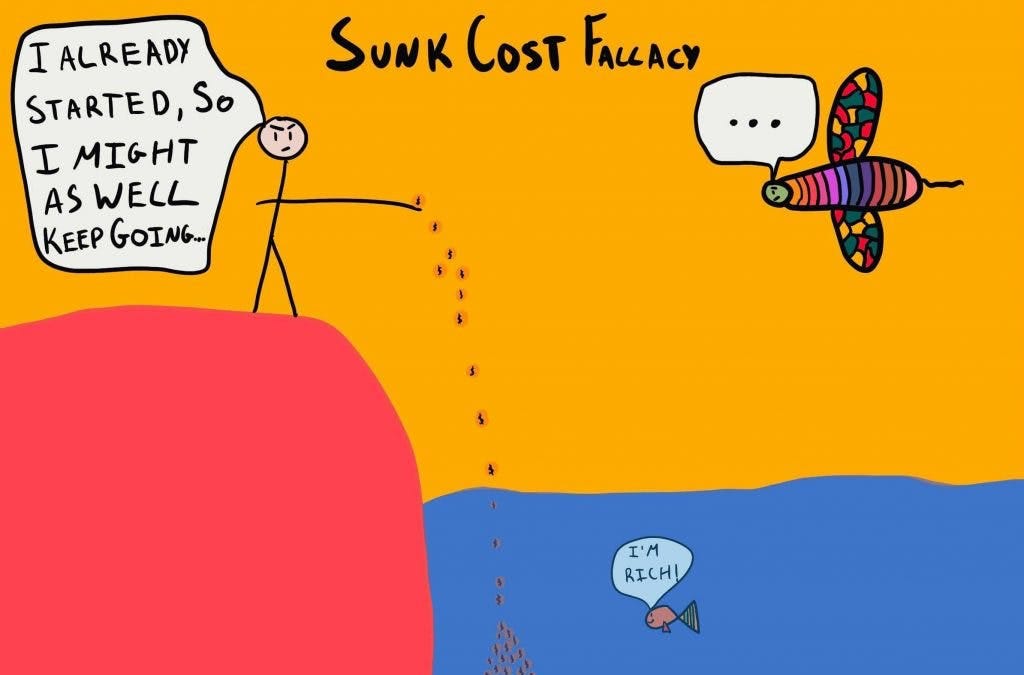
While charting my course through a career recovery after experiencing severe burnout, one of the most significant hurdles I’ve encountered has been confronting my own ingrained mental biases that influence my choices.
There’s no question that cognitive biases have profoundly shaped my decision-making processes, particularly during the initial phases of my healing journey. Among these, the Sunk Cost Fallacy stands out as especially common and deeply entrenched in professions notorious for elevated burnout levels. It’s crucial to recognize and understand this fallacy because it traps individuals in professional paths that no longer provide value and may even be detrimental to their well-being. Instead of evaluating prospective costs and advantages moving forward, people fixate on the resources already expended in the past.
Have you ever found yourself hesitating over a career crossroads, thinking something along the lines of, ‘I’ve invested so much time, energy, and effort here—I simply can’t walk away now’? Or maybe you’ve heard similar sentiments from a caring family member, friend, or coworker trying to encourage perseverance? This precise line of reasoning exemplifies the Sunk Cost Fallacy at work. It refers to the human inclination to persist with a commitment or course of action simply because substantial time, effort, money, or other resources have already been poured into it, even when continuing proves more costly than beneficial in the present circumstances.
The deeper the investment becomes, the stronger the psychological pull to keep going, often leading to even greater resource allocation to justify or complete the original choice, despite clear evidence that it may no longer align with one’s best interests or current reality. What makes cognitive biases particularly insidious is their intuitive appeal—they seem logical and rational at the time, operating beneath conscious awareness, which makes them incredibly challenging to identify and override.
In the context of burnout recovery, the Sunk Cost Fallacy actively sabotages our ability to select career moves that truly support healing and growth. A key driver behind susceptibility to this bias is loss aversion, a related psychological principle stating that the emotional sting of losses looms much larger in our minds than the pleasure derived from equivalent gains. As a result, individuals tend to prioritize avoiding potential losses over pursuing possible upsides. However, if this mindset compels someone to remain in a workplace that’s actively eroding their health due to prior commitments, true recovery becomes elusive and prolonged.
How to Overcome the Sunk Cost Fallacy
Managing this bias effectively requires deliberate effort, but it’s absolutely achievable with the right strategies. The core approach involves fundamentally redirecting your perspective away from historical investments and zeroing in exclusively on the projected costs and benefits that lie ahead. This means deliberately excluding any prior expenditures—whether monetary, temporal, emotional, or otherwise—from your present deliberations.
Direct your attention squarely on the present moment and the promising opportunities that could unfold in the future. Admittedly, this mental shift demands practice and persistence, yet it’s the essential pathway to breaking free from the Sunk Cost Fallacy’s grip. To reinforce this change, emphasize the establishment of SMART goals—those that are Specific, Measurable, Achievable, Relevant, and Time-bound—paired with tangible, actionable steps. Furthermore, develop a comprehensive roadmap outlining your immediate short-term objectives, alongside medium-term milestones and visionary long-term aspirations. This structured framework not only clarifies direction but also builds momentum toward decisions rooted in forward-thinking logic rather than past regrets.
By consistently applying these techniques, you empower yourself to make career choices that honor your current needs and future potential, unburdened by the weight of bygone investments. This approach fosters resilience against burnout’s lingering effects and opens doors to more fulfilling professional trajectories.